

- First Aid
- About Venom
- Clinical
- For Kids
- Research
- Reference
Necrotising arachnidism
Necrotising arachnidism describes the syndrome of blistering and ulceration or destruction (necrosis) of the skin following ...
Necrotising arachnidism
Necrotising arachnidism describes the syndrome of blistering and ulceration or destruction (necrosis) of the skin following spider bites. In some cases the problem can be severe with ongoing pain and tissue destruction requiring extensive debridement and skin grafting. The white-tailed spider (Lampona sp.) and the black window or black house spider (Badumna sp.) have been blamed for necrotising arachnidism in Australia. Wolf spiders (Lycosa sp.) have also been suspected in at least one case of suspected necrotising arachnidism. However, it appears that the majority of people bitten by these spiders suffer only minor local reactions. As the majority of spider bites are not reported, the proportion of bites that result in necrosis is unknown.
The reasons why some people develop more extensive skin lesions are unknown. It may be that only some species of spiders are associated with skin necrosis (there are several species of white-tailed spiders, all of a similar appearance.) It is possible that the spider's sex or geographic location may be important, or that venom composition or contents of the spiders' gastrointestinal tract may vary over time. Patient factors such as underlying vascular disease or immune response to the bite may also be involved. There is as yet no definitive treatment for this syndrome. It is likely that the overwhelming majority of such alleged cases are not even related to the effects of the spider venom.
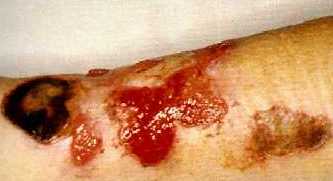
Comparison of Enzymatic Activity from Three Species of Necrotising Arachnids in Australia:. Loxosceles Rufescens, Badumna Insignis andLampona Cylindrata
Acute and Recurrent Skin Ulceration After Spider Bite
.
2000. Acute and Recurrent Skin Ulceration After Spider Bite. Wilderness Medical Society Summer Conference and Annual Meeting.
Acute and Recurrent Skin Ulceration After Spider Bite
.
1999. Acute and Recurrent Skin Ulceration After Spider Bite. The Medical Journal of Australia. 171(2):98-102.
