
Emergency Procedures
Emergency Procedures
In an emergency call 000.
Know the CPR procedure – The CPR (CardioPulmonary Resuscitation) procedure is when you carry out a cycle of rhythmic compression of the victim's chest, with inflation of their lungs, to assist their blood circulation and breathing.
Learn your DR-ABC – This list is used to help you remember what to do and the order in which to do it.
DR-ABC Summary pdf
D... Danger
D... Danger is first step in the DR-ABC procedure.
What is It? – An assessment of the scene for danger to ensure you, others and the victim are safe.
The CPR procedure The CPR (CardioPulmonary Resuscitation) procedure is when you carry out a cycle of rhythmic compression of the victim's chest, with inflation of their lungs, to assist their blood circulation and breathing. Select the ABC (Airway, Breathing, Compression) steps to see how this is done.
- Assess the Situation
|
Make sure that you are a safe distance away from the venomous animal. |
R... Response
R... Response is the check that you make for a response from the victim.
How is it Done? – Ask the victim to open their eyes and squeeze your hand. Or, see if the victim responds to touch by squeezing the victim's shoulders firmly.
If the patient is responsive – Apply the specific first aid technique and seek medical assistance. To do this click on the “First Aid Technique” link at the base of this panel and then select the appropriate First Aid technique for the specific venomous animal.
If the patient is unresponsive –
- If alone, immediately begin CPR procedure (steps ABC) for 2 minutes before calling 000 or seeking medical assistance. Continue CPR until the victim's breathing is normal and stable, or until medical assistance arrives.
- If others are around, immediately begin CPR procedure and have them call 000 or seek medical assistance.
- Apply specific first aid as soon as possible while maintaining CPR.
- Precautions should be taken to prevent any disease transmission. Wear gloves if available and wash your hands after first aid.
- If the victim shows signs of an allergic reaction and has Adrenaline with them, give this immediately.
- Always seek medical assistance, even if the victim appears well.
A... Airway
It is important that the patient can breathe so that you can carry out CPR.
How is it Done? – Open the patient's mouth, check the airway, and clear any potential obstruction from the mouth to ensure that the victim can breathe.
- Clear the Airway
|
Use your finger to clear the mouth and throat. |
B... Breathing
These steps are for YOU.
Look, Listen and Feel for signs that the patient is breathing.
How is it Done? –
- Check breathing with your cheek close to the victim's mouth.

- Take 5 to 10 seconds to check for normal breathing in an unresponsive victim.
- If the victim is not breathing normally, perform breathing assistance.
Tilt – place victim on their back, tilt the head back and lift the jaw to open the airway.
Blow – block the victim’s nose and give them 2 normal breaths (not deep breaths). Breath air into their mouth to inflate their chest twice (called 2 rescue breaths) at 1 second per breath.
Look – to ensure the chest rises with each breath.
Feel – for air being exhaled. - Immediately begin Chest Compression.
- Check Breathing
- Give Breathing Assistance
|
Look, Listen and Feel |
|
Block the victim’s nose and give them 2 normal breaths (not deep breaths). Breath air into their mouth to inflate their chest twice |
C... Compression
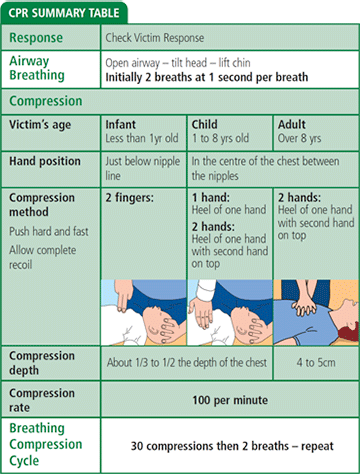
Use different methods depending on the age of the victim
(refer to CPR Summary Table)
How is it Done? –
- Push directly down with equal time for compression and relaxation. Avoid rocking backwards and forwards, using thumps or quick jabs.
- If unable or unwilling to perform breathing assistance, it is vital to perform the chest compression component of CPR.
- Apply specific first aid as soon as possible while maintaining CPR.
- Continue CPR until victim's breathing is normal and stable or medical assistance arrives.
- Compress the Victim's Chest
|
It is vital to continue the cycle of rhythmic compression of the victim's chest.
|
CPR Summary Table